

How A Bolt Is Made
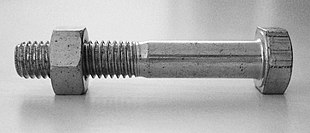
A bolt is a form of threaded fastener with an external male thread requiring a matching pre-formed female thread such as a nut. Bolts are very closely related to screws.[1]
Bolts vs. screws [edit]
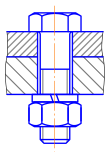

The distinction between a bolt and a screw is poorly-divers. The bookish stardom, per Machinery's Handbook,[ii] is in their intended pattern: bolts are designed to laissez passer through an unthreaded pigsty in a component and be fastened with the aid of a nut, although such a fastener tin can be used without a nut to tighten into a threaded component such equally a nut-plate or tapped housing. Screws in contrast are used in components which incorporate their ain thread, or to cut its ain internal thread into them. This definition allows ambiguity in the clarification of a fastener depending on the application it is really used for, and the terms screw and bolt are widely used past dissimilar people or in different countries to employ to the same or varying fastener.
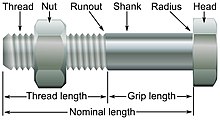
Bolts are often used to brand a bolted joint. This is a combination of the nut applying an axial clamping forcefulness and also the shank of the bolt acting as a dowel, pinning the articulation against sideways shear forces. For this reason, many bolts have a plain unthreaded shank (called the grip length ) as this makes for a better, stronger dowel. The presence of the unthreaded shank has ofttimes been given equally characteristic of bolts vs. screws,[3] but this is incidental to its apply, rather than defining.[ citation needed ]
Where a fastener forms its own thread in the component beingness attached, information technology is called a spiral.[2] This is most obviously then when the thread is tapered (i.e. traditional wood screws), precluding the apply of a nut,[2] or when a sheet metallic screw or other thread-forming screw is used. A spiral must ever exist turned to assemble the joint. Many bolts are held fixed in place during assembly, either past a tool or by a blueprint of non-rotating bolt, such as a railroad vehicle bolt, and only the respective nut is turned.[2]
Bolt heads [edit]
Bolts use a wide diversity of head designs, as do screws. These are designed to engage with the tool used to tighten them. Some bolt heads instead lock the bolt in identify, and then that it does not motion and a tool is merely needed for the nut end.
Common bolt heads include hex, slotted hex washer, and socket cap.
The first bolts had square heads, formed by forging. These are all the same found, although much more common today is the hexagonal head. These are held and turned by a spanner or socket, of which there are many forms. Most are held from the side, some from in-line with the bolt. Other bolts accept T-heads and slotted heads. [iv]
Many bolts employ a screwdriver head fitting, rather than an external wrench. Screwdrivers are practical in-line with the fastener, rather than from the side. These are smaller than most wrench heads and cannot commonly utilize the same corporeality of torque. Information technology is sometimes causeless that screwdriver heads imply a screw and wrenches imply a bolt, although this is wrong. Passenger vehicle screws are big square-headed screws with a tapered wood screw thread, used for attaching ironwork to timber. Head designs that overlap both bolts and screws are the Allen or Torx heads; hexagonal or splined sockets. These modern designs bridge a large range of sizes and tin can carry a considerable torque. Threaded fasteners with screwdriver-style heads are often referred to as machine screws whether they are existence used with a nut or not.[ commendation needed ]
Commodities types [edit]
- Ballast bolt - Bolt designed to allow objects to be attached to physical. The bolt head is normally placed in concrete before it has cured or placed earlier the physical is poured, leaving the threaded end exposed.
- Arbor bolt - Bolt with a washer permanently attached and reversed threading. Designed for use in miter saw and other tools to machine tighten during use to forestall blade fall out.
- Railroad vehicle bolt - Bolt with a smooth rounded head and a square section to prevent turning followed with a threaded section for a nut.
- Elevator bolt - Bolt with a big apartment head used in conveyor system setups.
- Hanger commodities - Bolt that has no head, machine threaded torso followed by a wood threaded screw tip. Allow nuts to exist fastened to what is really a spiral.
- Hex commodities - Bolt with a hexagonal head and threaded body. Section immediately under head may or may not be threaded.
- J commodities - Commodities shaped like the letter of the alphabet J. Used for tie downs. Only the non curved section is threaded for a nut to exist fastened.
- Lag bolt - Likewise known as lag spiral. Non a true bolt. Hex commodities head with thread screw tip for apply in wood.
- Rock bolt - Used in tunnel construction to stabilize walls.
- Sexual activity bolt or Chicago bolt - Bolt that has a male and female part with interior threads and bolt heads on either end. Commonly used in newspaper binding.
- Shoulder commodities or stripper bolt - Bolt with a wide smoothen shoulder and small threaded finish used to create a pivot or zipper point.
- U-bolt - Bolt shaped like the letter of the alphabet U where the two directly sections are threaded. A straight metal plate with ii bolt holes is used with nuts to concur pipes or other circular objects to the U-bolt.
- Cane commodities - Also chosen a drib rod, a cane bolt is not a threaded fastener. Information technology is a blazon of gate latch that consists of a long metallic rod with a curved handle and attaches to a gate by one or more fasteners. This blazon of bolt was named afterwards the shape of a cane, similar to the shape of a candy cane or walking cane.
Bolt materials [edit]
Depending on required strength and circumstances, there are several textile types can be used for fasteners.[5]
- Steel fasteners (grade 2,5,viii) - the level of strength
- Stainless steel fasteners (martensitic stainless steel, austenitic stainless steel),
- Bronze and brass fasteners - h2o proof usage
- Nylon fasteners - used for the light material and water proof usage.
In general, steel is the nigh commonly used material of all fasteners: 90% or more.[ citation needed ]
Bolted joints [edit]

Rusty hexagonal bolt heads
The American Institute of Steel Construction (AISC) 13th Edition Steel Pattern Manual section 16.1 affiliate J-three specifies the requirements for bolted structural connections. Structural bolts replaced rivets due to the decreasing cost and increasing strength of structural bolts in the 20th century. Connections are formed with 2 types of joints: slip-critical connections and bearing connections. In skid-critical connections, motion of the connected parts is a serviceability condition and bolts are tightened to a minimum required pre-tension. Sideslip is prevented through friction of the "faying" surface, that is the plane of shear for the bolt and where two members make contact. Considering friction is proportional to the normal force, connections must be sized with bolts numerous and large enough to provide the required load capacity. However, this greatly decreases the shear capacity of each bolt in the connexion. The second (and more than common type) of connection is a begetting connection. In this type of connection, the bolts carry the load through shear and are only tightened to a "snug-fit". These connections crave fewer bolts than sideslip-critical connections and therefore are a less expensive alternative. Slip-critical connections are more than common on flange plates for beam and column splices and moment disquisitional connections. Bearing type connections are used in lightweight structures and in member connections where slip is non of import and prevention of structural failure is the design constraint. Mutual begetting type connections include: shear tabs, beam supports, gusset plates in trusses.[ commendation needed ]
Run across as well [edit]
- ASTM A325, standard for bolts 1⁄2 to one+ 1⁄2 inches (12.7 to 38.one mm) in bore
- ISO 898, standard for metric bolts
- Mechanical articulation
- Screw thread
- Socket wrench
- Thread angle
- Thread-locking chemical compound
- Thread pitch gauge
- Torque wrench
References [edit]

Wikimedia Commons has media related to Bolts.
- ^ "Commodities | Definition of Bolt by Merriam-Webster". Merriam-webster.com. Retrieved xi April 2016.
- ^ a b c d Machinery's Handbook (Twenty-Showtime ed.). New York: Industrial Press. 1980. p. 1131.
- ^ Dyke'south Motorcar and Gasoline Engine Encyclopedia. A. L. Dyke. 1919. p. 701. ISBN9780140806137.
sae uss spiral standard.
- ^ "What is a bolt?". AALL American Fasteners.
- ^ "Fastener Fabric Choice". www.thomasnet.com.

How A Bolt Is Made,
Source: https://en.wikipedia.org/wiki/Bolt_(fastener)
Posted by: mcnairoffam1938.blogspot.com
0 Response to "How A Bolt Is Made"
Post a Comment