

Area Element In Polar Coordinates
10.2: Expanse and Volume Elements
- Page ID
- 106863
In whatever coordinate arrangement information technology is useful to define a differential area and a differential volume chemical element. In cartesian coordinates the differential area element is simply \(dA=dx\;dy\) (Figure \(\PageIndex{1}\)), and the volume element is merely \(dV=dx\;dy\;dz\).
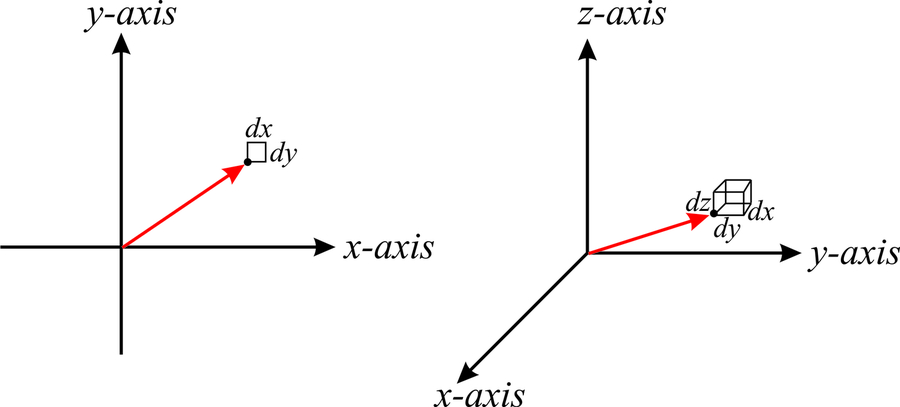
We already performed double and triple integrals in cartesian coordinates, and used the area and book elements without paying whatever special attention. For example, in example [c2v:c2vex1], we were required to integrate the office \({\left | \psi (x,y,z) \correct |}^2\) over all infinite, and without thinking too much nosotros used the volume element \(dx\;dy\;dz\) (see page ). We also knew that "all space" meant \(-\infty\leq x\leq \infty\), \(-\infty\leq y\leq \infty\) and \(-\infty\leq z\leq \infty\), and therefore we wrote:
\[\int_{-\infty }^{\infty }\int_{-\infty }^{\infty }\int_{-\infty }^{\infty }{\left | \psi (x,y,z) \correct |}^2\; dx \;dy \;dz=1 \nonumber\]
But what if we had to integrate a role that is expressed in spherical coordinates? Would nosotros just replace \(dx\;dy\;dz\) by \(dr\; d\theta\; d\phi\)? The answer is no, because the book chemical element in spherical coordinates depends also on the bodily position of the point. This will make more than sense in a minute. Coming back to coordinates in ii dimensions, it is intuitive to empathise why the area chemical element in cartesian coordinates is \(dA=dx\;dy\) independently of the values of \(x\) and \(y\). This is shown in the left side of Effigy \(\PageIndex{ii}\). All the same, in polar coordinates, we see that the areas of the gray sections, which are both constructed by increasing \(r\) past \(dr\), and by increasing \(\theta\) by \(d\theta\), depend on the actual value of \(r\). Find that the expanse highlighted in gray increases as nosotros move abroad from the origin.
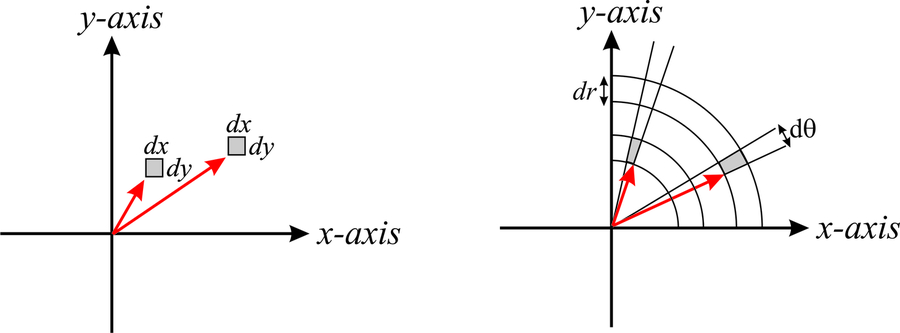
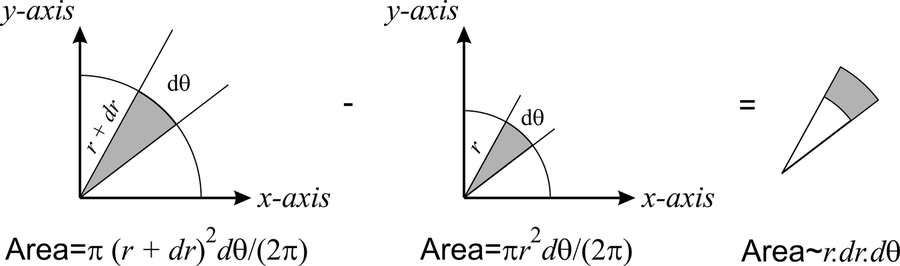
The area shown in grayness can be calculated from geometrical arguments equally
\[dA=\left[\pi (r+dr)^2- \pi r^2\correct]\dfrac{d\theta}{2\pi}.\]
Because \(dr<<0\), we tin fail the term \((dr)^two\), and \(dA= r\; dr\;d\theta\) (see Figure \(10.two.three\)).
Let's come across how this affects a double integral with an instance from breakthrough mechanics. The wave function of the ground country of a two dimensional harmonic oscillator is: \(\psi(x,y)=A eastward^{-a(10^two+y^2)}\). We know that the quantity \(|\psi|^2\) represents a probability density, and as such, needs to exist normalized:
\[\int\limits_{all\;space} |\psi|^2\;dA=1 \nonumber\]
This argument is truthful regardless of whether the function is expressed in polar or cartesian coordinates. However, the limits of integration, and the expression used for \(dA\), volition depend on the coordinate system used in the integration.
In cartesian coordinates, "all infinite" means \(-\infty<x<\infty\) and \(-\infty<y<\infty\). The differential of area is \(dA=dxdy\):
\[\int\limits_{all\;infinite} |\psi|^2\;dA=\int\limits_{-\infty}^{\infty}\int\limits_{-\infty}^{\infty} A^2e^{-2a(ten^2+y^ii)}\;dxdy=one \nonumber\]
In polar coordinates, "all space" means \(0<r<\infty\) and \(0<\theta<2\pi\). The differential of area is \(dA=r\;drd\theta\). The function \(\psi(x,y)=A e^{-a(ten^two+y^2)}\) can be expressed in polar coordinates every bit: \(\psi(r,\theta)=A eastward^{-ar^2}\)
\[\int\limits_{all\;space} |\psi|^two\;dA=\int\limits_{0}^{\infty}\int\limits_{0}^{2\pi} A^2 eastward^{-2ar^ii}r\;d\theta dr=ane \nonumber\]
Both versions of the double integral are equivalent, and both tin be solved to find the value of the normalization constant (\(A\)) that makes the double integral equal to 1. In polar coordinates:
\[\int\limits_{0}^{\infty}\int\limits_{0}^{2\pi} A^2 e^{-2ar^two}r\;d\theta dr=A^2\int\limits_{0}^{\infty}e^{-2ar^2}r\;dr\int\limits_{0}^{ii\pi}\;d\theta =A^2\times\dfrac{1}{4a}\times2\pi=1 \nonumber\]
Thereforeane, \(A=\sqrt{2a/\pi}\). The same value is of grade obtained by integrating in cartesian coordinates.
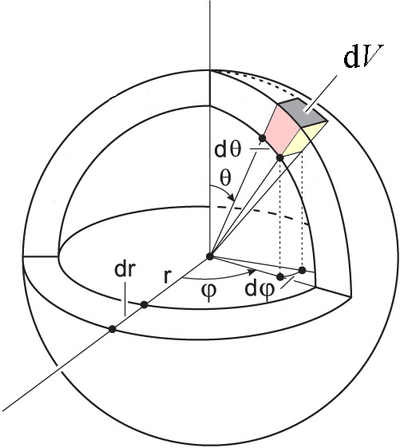
It is at present time to turn our attention to triple integrals in spherical coordinates. In cartesian coordinates, the differential volume element is simply \(dV= dx\,dy\,dz\), regardless of the values of \(ten, y\) and \(z\). Using the same arguments we used for polar coordinates in the plane, we will run into that the differential of volume in spherical coordinates is not \(dV=dr\,d\theta\,d\phi\). The geometrical derivation of the volume is a petty bit more complicated, only from Figure \(\PageIndex{iv}\) yous should be able to see that \(dV\) depends on \(r\) and \(\theta\), merely non on \(\phi\). The volume of the shaded region is
\[\label{eq:dv} dV=r^2\sin\theta\,d\theta\,d\phi\,dr\]
We will exemplify the use of triple integrals in spherical coordinates with some problems from quantum mechanics. We already introduced the Schrödinger equation, and fifty-fifty solved it for a unproblematic system in Section 5.4. Nosotros also mentioned that spherical coordinates are the obvious pick when writing this and other equations for systems such equally atoms, which are symmetric effectually a point.
Every bit we saw in the example of the particle in the box (Section 5.4), the solution of the Schrödinger equation has an arbitrary multiplicative constant. Because of the probabilistic interpretation of wave functions, we determine this constant by normalization. The same state of affairs arises in 3 dimensions when nosotros solve the Schrödinger equation to obtain the expressions that describe the possible states of the electron in the hydrogen atom (i.e. the orbitals of the cantlet). The Schrödinger equation is a partial differential equation in three dimensions, and the solutions volition exist moving ridge functions that are functions of \(r, \theta\) and \(\phi\). The lowest free energy state, which in chemistry we call the 1s orbital, turns out to be:
\[\psi_{1s}=Ae^{-r/a_0} \nonumber\]
This particular orbital depends on \(r\) merely, which should not surprise a chemist given that the electron density in all \(due south\)-orbitals is spherically symmetric. We will encounter that \(p\) and \(d\) orbitals depend on the angles as well. Regardless of the orbital, and the coordinate system, the normalization status states that:
\[\int\limits_{all\;space} |\psi|^2\;dV=1 \nonumber\]
For a moving ridge function expressed in cartesian coordinates,
\[\int\limits_{all\;space} |\psi|^2\;dV=\int\limits_{-\infty}^{\infty}\int\limits_{-\infty}^{\infty}\int\limits_{-\infty}^{\infty}\psi^*(ten,y,z)\psi(ten,y,z)\,dxdydz \nonumber\]
where we used the fact that \(|\psi|^two=\psi^* \psi\).
In spherical coordinates, "all space" means \(0\leq r\leq \infty\), \(0\leq \phi\leq 2\pi\) and \(0\leq \theta\leq \pi\). The differential \(dV\) is \(dV=r^2\sin\theta\,d\theta\,d\phi\,dr\), and so
\[\int\limits_{all\;infinite} |\psi|^2\;dV=\int\limits_{0}^{2\pi}\int\limits_{0}^{\pi}\int\limits_{0}^{\infty}\psi^*(r,\theta,\phi)\psi(r,\theta,\phi)\,r^two\sin\theta\,dr d\theta d\phi=1 \nonumber\]
Let's see how we can normalize orbitals using triple integrals in spherical coordinates.
Example \(\PageIndex{ane}\)
When solving the Schrödinger equation for the hydrogen cantlet, we obtain \(\psi_{1s}=Ae^{-r/a_0}\), where \(A\) is an arbitrary abiding that needs to exist determined by normalization. Find \(A\).
Solution
In spherical coordinates,
\[\int\limits_{all\; space} |\psi|^two\;dV=\int\limits_{0}^{two\pi}\int\limits_{0}^{\pi}\int\limits_{0}^{\infty}\psi^*(r,\theta,\phi)\psi(r,\theta,\phi)\,r^2\sin\theta\,dr d\theta d\phi=ane \nonumber\]
because this orbital is a real function, \(\psi^*(r,\theta,\phi)\psi(r,\theta,\phi)=\psi^2(r,\theta,\phi)\). In this example, \(\psi^2(r,\theta,\phi)=A^2e^{-2r/a_0}\).
Therefore,
\[\int\limits_{0}^{two\pi}\int\limits_{0}^{\pi}\int\limits_{0}^{\infty}\psi^*(r,\theta,\phi)\psi(r,\theta,\phi) \, r^2 \sin\theta \, dr d\theta d\phi=\int\limits_{0}^{2\pi}\int\limits_{0}^{\pi}\int\limits_{0}^{\infty}A^2e^{-2r/a_0}\,r^ii\sin\theta\,dr d\theta d\phi=i \nonumber\]
\[\int\limits_{0}^{2\pi}\int\limits_{0}^{\pi}\int\limits_{0}^{\infty}A^2e^{-2r/a_0}\,r^2\sin\theta\,dr d\theta d\phi=A^2\int\limits_{0}^{2\pi}d\phi\int\limits_{0}^{\pi}\sin\theta \;d\theta\int\limits_{0}^{\infty}e^{-2r/a_0}\,r^2\;dr \nonumber\]
The result is a product of three integrals in one variable:
\[\int\limits_{0}^{two\pi}d\phi=2\pi \nonumber\]
\[\int\limits_{0}^{\pi}\sin\theta \;d\theta=-\cos\theta|_{0}^{\pi}=2 \nonumber\]
\[\int\limits_{0}^{\infty}due east^{-2r/a_0}\,r^two\;dr=? \nonumber\]
From the formula sheet:
\[\int_{0}^{\infty}10^ne^{-ax}dx=\dfrac{north!}{a^{north+1}}, \nonumber\]
where \(a>0\) and \(n\) is a positive integer.
In this instance, \(n=ii\) and \(a=ii/a_0\), so:
\[\int\limits_{0}^{\infty}east^{-2r/a_0}\,r^2\;dr=\dfrac{2!}{(2/a_0)^3}=\dfrac{2}{8/a_0^three}=\dfrac{a_0^3}{four} \nonumber\]
Putting the three pieces together:
\[A^2\int\limits_{0}^{2\pi}d\phi\int\limits_{0}^{\pi}\sin\theta \;d\theta\int\limits_{0}^{\infty}e^{-2r/a_0}\,r^ii\;dr=A^two\times2\pi\times2\times \dfrac{a_0^3}{4}=i \nonumber\]
\[A^2\times \pi \times a_0^three=1\rightarrow A=\dfrac{1}{\sqrt{\pi a_0^3}} \nonumber\]
The normalized 1s orbital is, therefore:
\[\displaystyle{\color{Maroon}\dfrac{1}{\sqrt{\pi a_0^three}}e^{-r/a_0}} \nonumber\]

Area Element In Polar Coordinates,
Source: https://chem.libretexts.org/Bookshelves/Physical_and_Theoretical_Chemistry_Textbook_Maps/Book:_Mathematical_Methods_in_Chemistry_%28Levitus%29/10:_Plane_Polar_and_Spherical_Coordinates/10.02:_Area_and_Volume_Elements
Posted by: mcnairoffam1938.blogspot.com
0 Response to "Area Element In Polar Coordinates"
Post a Comment